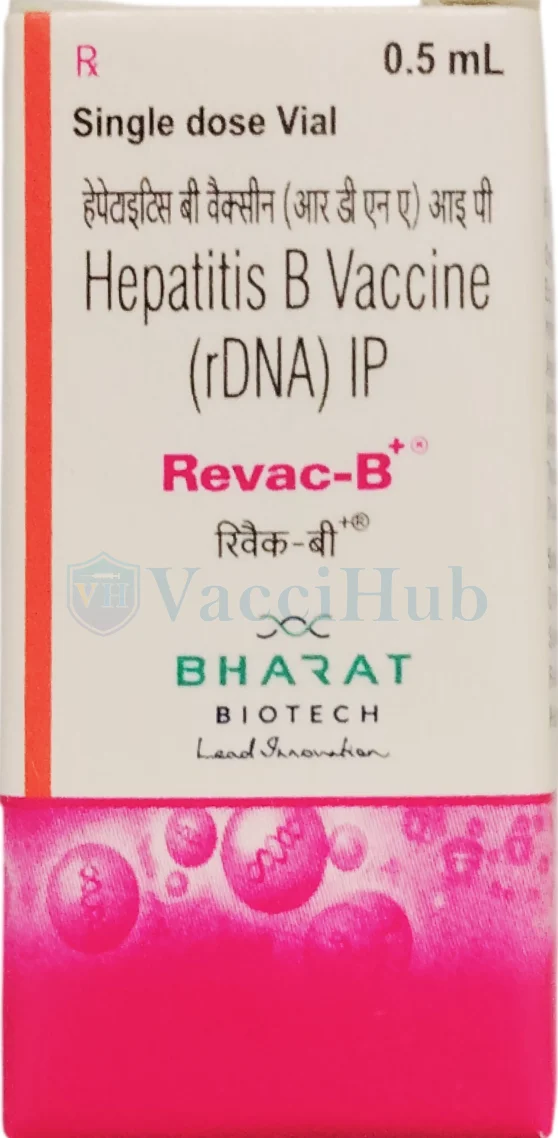
REVAC-B PAED® · Bharat Biotech · 0.5 mL Single Dose Vial · Intramuscular Injection
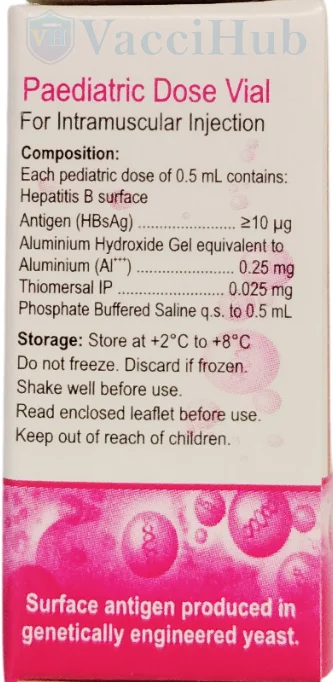
Composition · Batch & Storage Details · See product insert for full prescribing information
Hepatitis B virus (HBV) can cause chronic liver disease, cirrhosis and liver cancer. India carries one of the world's largest chronic HBV burdens, with tens of millions of chronic carriers.
In India, the most common way infants acquire HBV is transmission from an infected mother at birth. Without prompt vaccination, up to 90% of infected newborns go on to develop chronic infection.
A completed vaccine series produces protective antibodies in roughly 95% of recipients, and the Hepatitis B vaccine remains the only licensed vaccine proven to help prevent a form of liver cancer.
REVAC-B PAED uses recombinant DNA technology: HBsAg is expressed in yeast cells, purified, and formulated without any live virus, giving a consistent, well-tolerated antigen source.
The single most important dose. IAP guidance calls for the first Hepatitis B dose within 24 hours of birth for every newborn, to block mother-to-child transmission.
Doses 2, 3 and 4 are usually given as part of a 6-in-1 combination vaccine at 6, 10 and 14 weeks, continuing protection built by the birth dose.
Children under 20 who missed their birth dose or infant series can start a 3-dose catch-up schedule (0, 1, 6 months) at any time.
Children travelling to Hepatitis B endemic regions in Southeast Asia or Sub-Saharan Africa should complete their series before travel; accelerated schedules are available if time is short.
Children living with an HBsAg-positive family member are at ongoing risk and should be fully vaccinated, with an anti-HBs titre check where advised by the paediatrician.
Adults 20 years and above should receive the 1 mL Revac-B+ presentation rather than REVAC-B PAED – see our Revac-B+ Adult page.
As per Bharat Biotech manufacturer labelling for the paediatric presentation. Always refer to the product insert in the pack for exact per-batch quantities.
| Component | Approx. Quantity | Role |
|---|---|---|
| Active Ingredient | ||
| Purified HBsAg (Hepatitis B Surface Antigen) | ≥ 10 µg | Recombinant antigen produced in yeast (rDNA). Triggers protective anti-HBs antibody response. No live virus. |
| Adjuvant | ||
| Aluminium Hydroxide gel | Proportional to 0.5 mL dose | Creates a depot at the injection site, prolonging antigen exposure and boosting the immune response. |
| Preservative | ||
| Thiomersal I.P. | Trace amount (multi-dose vial standard) | Ethylmercury-based preservative. Cleared from the body quickly; considered safe at vaccine doses by WHO and DCGI. |
| Dosage Form | ||
| Form | Suspension for IM injection | Shake well – the adjuvant settles on standing. |
| Route | Intramuscular only | Anterolateral thigh (infants) · Deltoid (older children) |
| Storage | 2°C to 8°C | DO NOT FREEZE · Shake well before use |
| Dose | Age / Timing | Vaccine | Notes |
|---|---|---|---|
| Infant Primary Series (4 Doses Total) | |||
| Birth Dose | Within 24 hours of birth | REVAC-B PAED (0.5 mL) monovalent | Most critical dose – blocks mother-to-child transmission |
| Dose 2 | 6 weeks | As part of 6-in-1 combination | HepB component of hexavalent vaccine |
| Dose 3 | 10 weeks | As part of 6-in-1 combination | HepB component of hexavalent vaccine |
| Dose 4 | 14 weeks | As part of 6-in-1 combination | Completes the 4-dose infant series |
| Child Catch-Up Schedule (3 Doses, Under 20 Years) | |||
| Dose 1 | Day 0 | REVAC-B PAED (0.5 mL) | Any unvaccinated child under 20 years |
| Dose 2 | 1 month after Dose 1 | REVAC-B PAED (0.5 mL) | Minimum 4 weeks after Dose 1 |
| Dose 3 | 6 months after Dose 1 | REVAC-B PAED (0.5 mL) | Completes the series |
Antigen injected intramuscularly. After shaking well, the 0.5 mL dose is injected into the anterolateral thigh (infants) or deltoid (older children). The aluminium-adsorbed HBsAg forms a slow-release depot at the injection site.
Immune system recognises HBsAg as foreign. Antigen-presenting cells process the surface antigen and display it to T-helper cells, while the adjuvant boosts the surrounding immune signalling.
Protective antibodies are produced. B-cells mature into plasma cells that secrete anti-HBs antibodies, which bind and neutralise HBV particles, preventing them from infecting liver cells.
Long-term immune memory is established. After completing the full series, most healthy children develop lasting seroprotection (anti-HBs ≥ 10 mIU/mL), with memory cells ready to respond quickly if exposed later.
REVAC-B PAED has a well-established safety profile; Hepatitis B vaccines are among the most widely used and best-studied vaccines given to infants worldwide.
There is a known hypersensitivity to yeast or any vaccine component (including thiomersal); there has been anaphylaxis after a previous dose of any Hepatitis B vaccine; or the child has acute severe febrile illness on the day of vaccination (defer until recovery).
Preterm or low birth-weight infants: the birth dose is still recommended, though some paediatricians adjust timing based on clinical stability – follow your doctor's advice.
Immunocompromised children: may need additional doses or antibody titre checks after completing the series.
Bleeding disorders: a fine needle with firm post-injection pressure is used to reduce bruising risk.
Urgent home visits within 24 hours of delivery, at your home or hospital of delivery.
Cold boxes maintained at 2–8°C with freeze-indicator checks before every dose.
Sourced only from authorised distributors, with batch details shared on WhatsApp after every visit.
Birth dose and all follow-up doses tracked with WhatsApp reminders so no dose is missed.
No hospital queues – especially valuable for newborns and young children.
Priority scheduling for birth-dose requests; flexible slots for the rest of the series.
Call +91 92050 04114 anytime – urgent birth-dose requests are given priority.
Copyright © All Rights Reserved VacciHub by PSTRIDE SOLUTIONS LLP